
4/ A Glass Interruption on a Parisian Street
Paris has never been short on cafés, but it remains surprisingly selective about how new ones announce themselves. In a city defined by continuity—Haussmannian stone façades, wrought-iron balconies, and a rhythm that has endured for over a century—any architectural intervention is immediately legible as either respectful or intrusive. The most interesting projects today sit deliberately between those two poles.
This small coffee shop does exactly that.
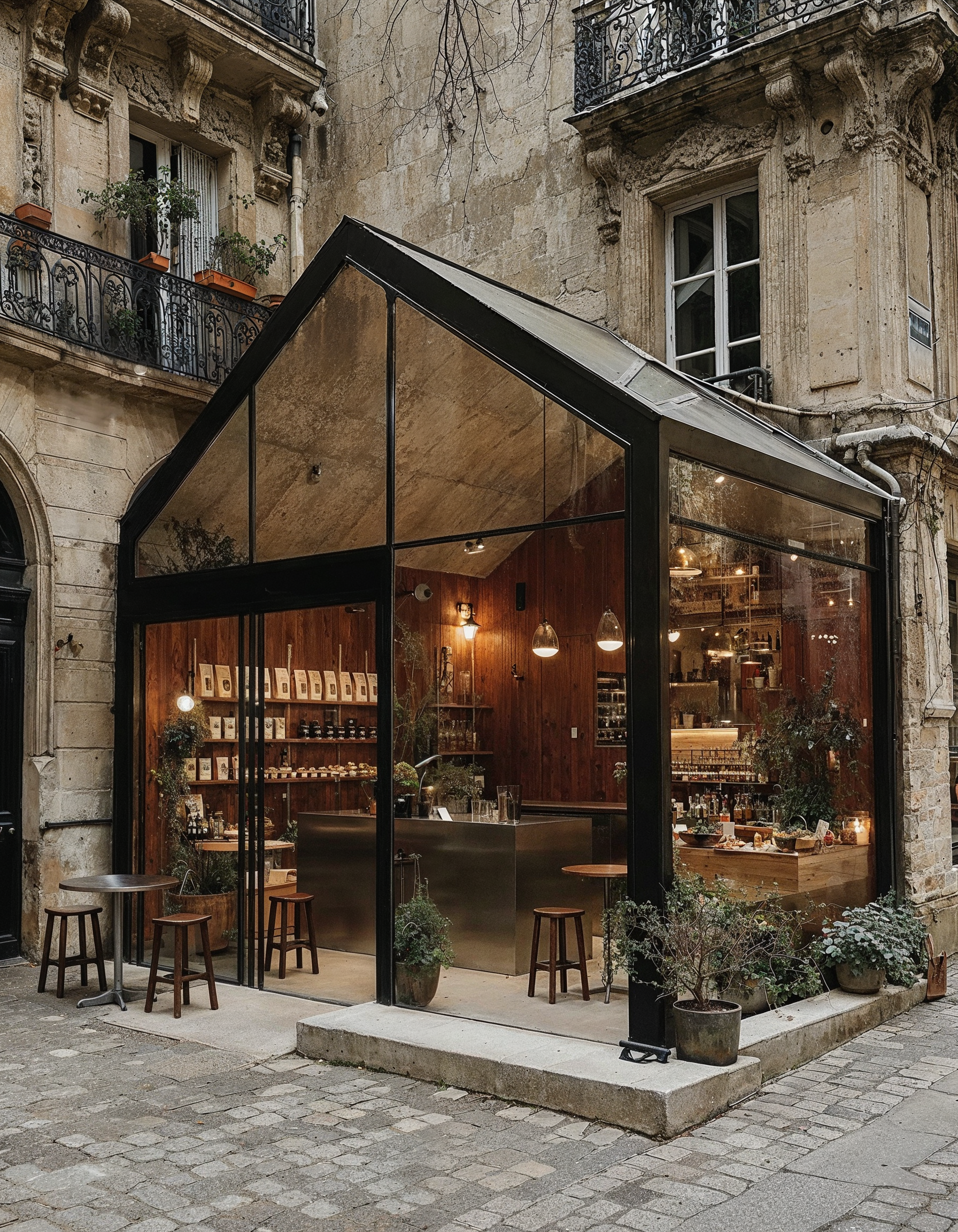
Inserted into the ground floor of a traditional Haussmannian building, the café announces itself not through signage or color, but through form. A contemporary glass volume gently projects from the historic façade, breaking the planar rigidity of the stone without overwhelming it. The intervention feels precise rather than expressive: a clean steel frame, floor-to-ceiling glazing, and a transparent roof that allows the interior to glow outward, particularly in the early evening hours.
Rather than compete with the building above it, the café reads as a temporary structure—almost a pavilion—nestled into the city’s fabric.
Transparency as Invitation
The fully glazed roof is the project’s most defining gesture. In a city where interiors are often hidden behind heavy façades, the transparency here feels almost radical. Daylight filters through the roof during the morning hours, softening the interior and revealing the textures of wood and steel within. At night, the effect reverses: warm, amber-toned light spills upward, turning the café into a lantern embedded in stone.
This transparency creates an unspoken invitation. There is no threshold in the traditional sense—no heavy door, no visual barrier. From the street, the ritual of coffee is fully visible: the stainless steel counter, the movement behind the bar, the quiet choreography of cups, tools, and hands.
Material Contrast, Carefully Balanced
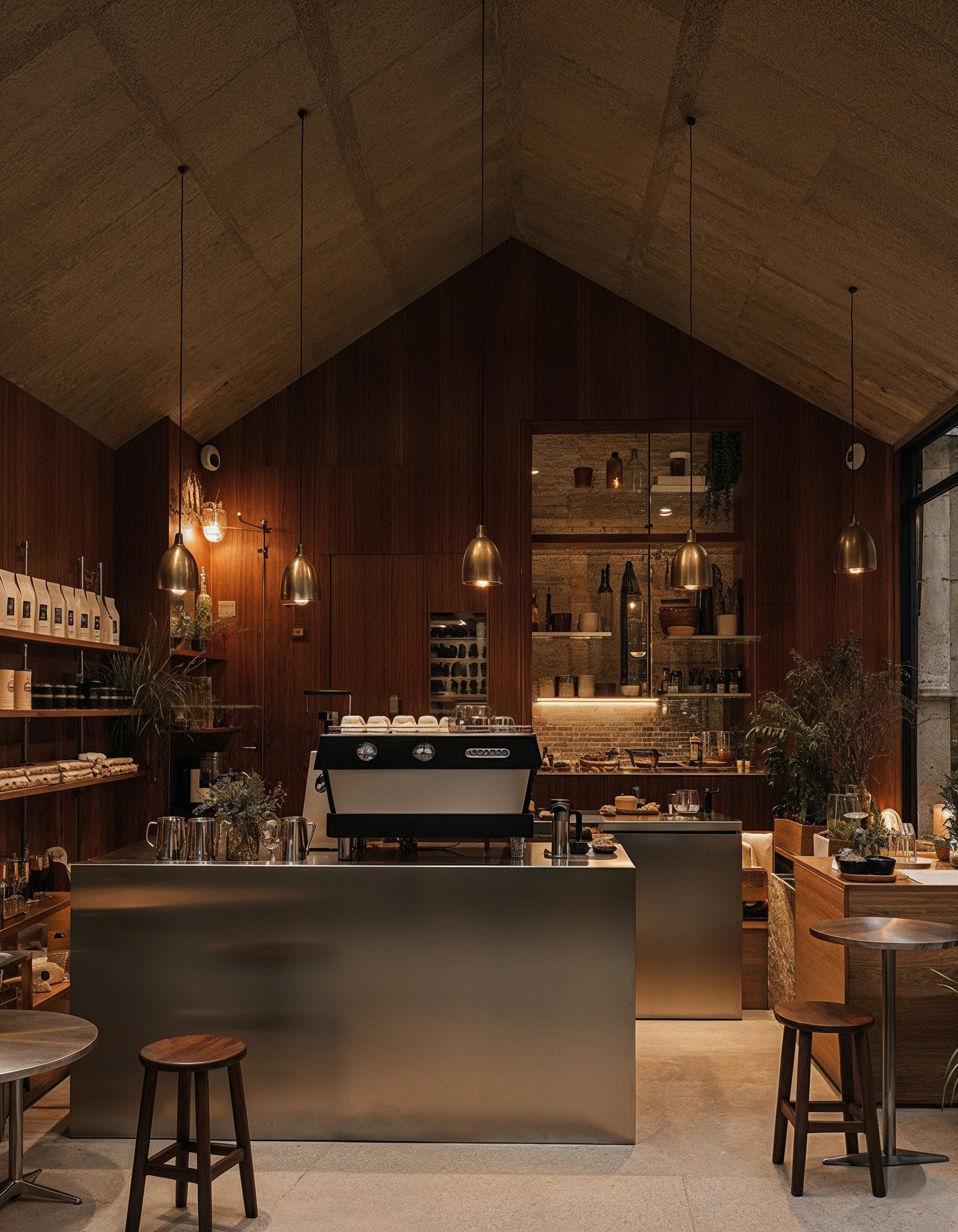
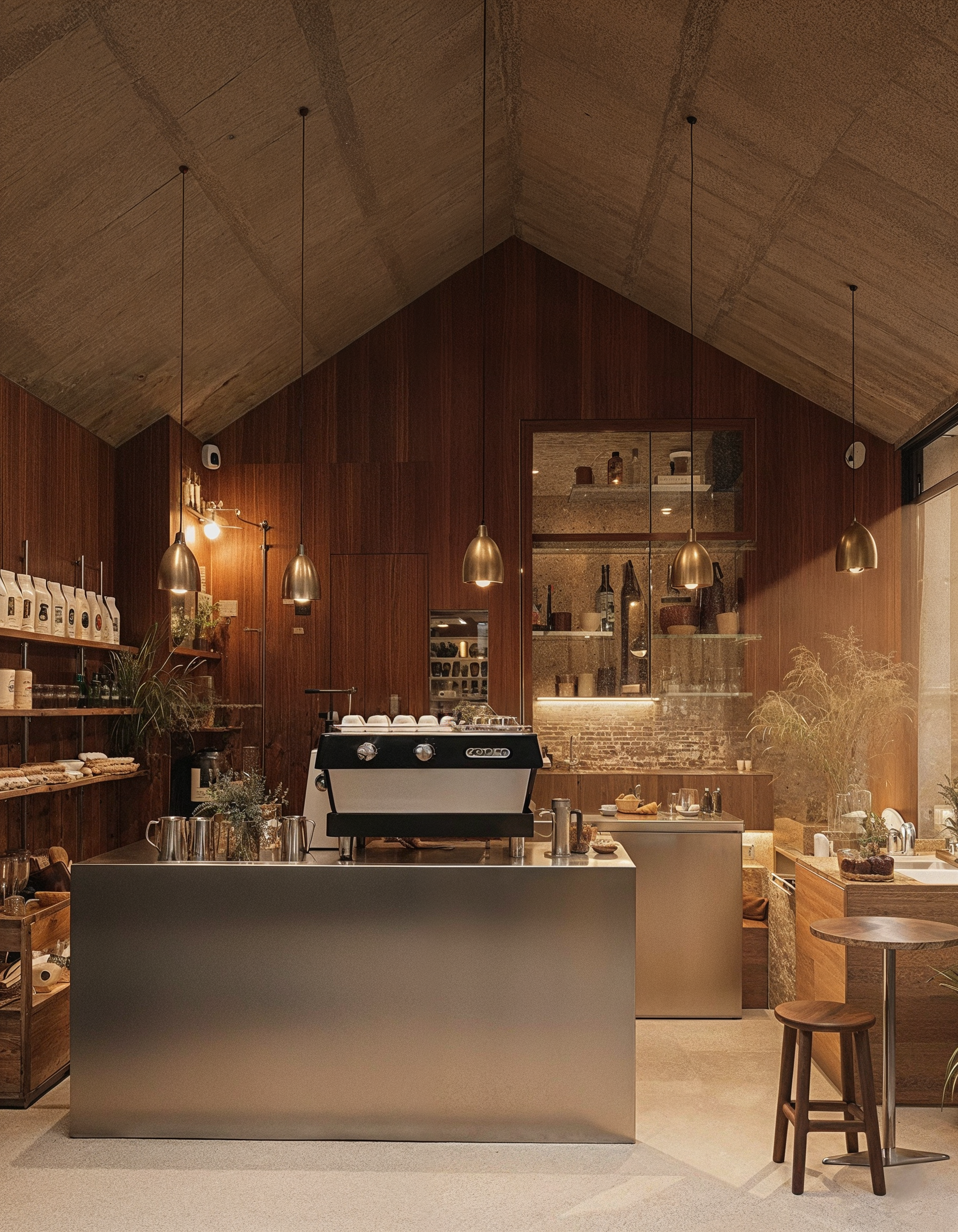
Inside, the palette is restrained but deliberate. Stainless steel dominates the counters and tables, lending the space a clarity and precision that feels almost industrial. This is softened by extensive wood paneling and cabinetry, stained in deep, warm tones that verge on burgundy under the café’s lighting scheme. The result is a carefully tuned contrast: steel for function and rigor, wood for warmth and atmosphere.
The lighting leans decisively toward orange and amber hues, avoiding the cooler temperatures often associated with contemporary interiors. This choice anchors the space emotionally. The steel surfaces catch the warm light and reflect it softly, while the darker walls absorb it, creating a sense of intimacy even within a fully glazed structure.
Plants are present, but sparingly so. Rather than lush greenery, they appear as accents—architectural punctuation rather than decoration.
A Contemporary Café, Parisian in Spirit
What makes this project distinctly Parisian is not its aesthetic references, but its restraint. The design does not attempt to mimic historic details, nor does it aggressively reject them. Instead, it proposes a quiet coexistence: a contemporary layer that acknowledges the permanence of the city around it.
In many ways, this café reflects a broader shift in Parisian coffee culture. The new generation of cafés is less concerned with nostalgia and more focused on craft, material honesty, and spatial clarity. Coffee here is not a performance, but a process—visible, deliberate, and calm.
The architecture supports that philosophy. It frames the act of making coffee as something worth observing, without turning it into spectacle.
An Urban Moment, Brief and Intentional
Perhaps the most compelling aspect of this café is its apparent modesty. Despite its architectural confidence, it does not attempt to redefine the street or dominate its surroundings. Instead, it offers a moment—an interruption in stone, a pause in routine, a warm interior revealed through glass.
In a city as dense with history as Paris, that restraint is not a limitation. It is a design choice.
And one that feels entirely at home.
This design is only a concept and does not exist*
